

Moving from Level A to the CASAS STEPS Reading Test Level B (common for ESOL 2) is a big step: texts get a little longer, there’s more real-world reading, and charts/tables appear for the first time. Level B has 36 questions and allows up to 50 minutes. This guide explains each Level B task area, shows sample screenshots, and estimates how many questions you’ll see in each category—so you can study smarter.
If you missed it, start with our Level A task-areas post or our broader CASAS STEPS Reading overview.
Level B Task-Area Distribution
Based on the Level B pie chart below (from the official CASAS website), the distribution is:

- Forms — 24% → about 9 questions
- Charts, Tables & Graphs — 15% → about 5–6 questions
- Texts, Emails, Short Articles, Narratives — 31% → about 11 questions
- Signs, Ads & Labels — 30% → about 11 questions
Note: Exact counts can vary slightly by form, but these estimates match the blueprint proportions and help you plan your practice time.
Task Area 1: Forms (24%) — about 9 questions
What you’ll see: In the CASAS STEPS Reading Level B test, you will see everyday forms such as school/clinic slips, sign-in sheets, simple applications. The question line asks for a specific detail (e.g., date, time, phone, room). Compared with Level A, more fields may be present, so be precise.
How to answer: Read the question first, then scan for the matching label on the form. Confirm formatting (e.g., MM/DD vs DD/MM). Avoid “looks right”—always verify the label.

Task Area 2: Charts, Tables & Graphs (15%) — about 5–6 questions
New at CASAS STEPS Reading Level B: simple charts and tables such as class schedules, bus timetables, and store hours. You’ll match one specific detail by reading the correct row and column. Graphs, when present, are very basic.
How to answer: Identify the row (e.g., “Bus 12” or “Math”) and the column (e.g., “Tuesday” or “Departure”). Most errors happen from scanning the wrong line—slow down just enough to line up labels correctly.

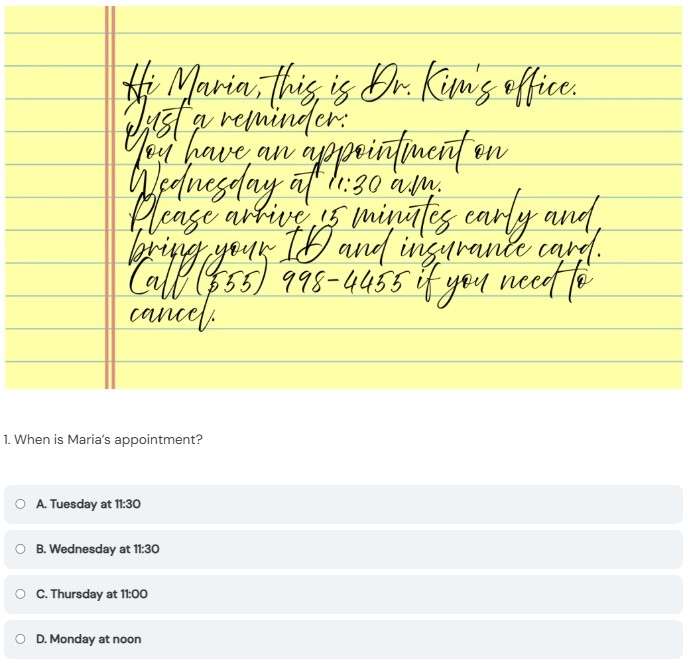
Task Area 3: Texts, Emails, Short Articles, Narratives (31%) — about 11 questions
This is the largest category at CASAS STEPS Reading Level B. You’ll read short notices, emails, reminders, and brief community/workplace texts. Questions target key details (who/what/when/where) and often the purpose/main idea (why the message was written).
How to answer: Read the question first. Then skim for names, dates, times, locations, and action words (e.g., “bring,” “moved,” “confirm”). For purpose/main idea, ask: “Is this to inform, invite, request, or remind?”
Task Area 4: Signs, Ads & Labels (30%) — about 11 questions
You’ll interpret store ads, posted notices, product/medicine labels, and other short texts. Compared with Level A, these are usually text-based with a question line (rather than picture-only). Expect numbers, abbreviations, and concise phrases.
How to answer: Zero in on numbers (prices, dates, times, dosages) and common abbreviations (Mon., Dec., Ave., Apt., tsp.). Read exactly what’s printed—don’t assume or infer extra information.

Check out this other example of a medicine label: The question is “When should you take this medicine?” The label doesn’t say the time, but it says “Nighttime Cold and Flu Relief,” so the answer is “At night.” Sometimes, it is not only about looking at numbers or names, but also you have to look for synonyms.

Study Strategy: Turn the Blueprint Into a Plan
- Prioritize by weight: Spend the most time on Texts (≈11 Qs) and Signs/Ads/Labels (≈11 Qs).
- Don’t skip charts: Even at ~5–6 questions, tables can swing your score. Practice bus schedules and class timetables.
- Forms accuracy: Practice reading labels carefully—date vs. birthdate, phone vs. ID, room vs. building.
- Build real-world reading: Use flyers, posted notices, store ads, and labels you see every day.
- Take realistic practice: Try our free CASAS STEPS Reading practice quizzes by level and unit to mirror test formats.
Final Thoughts
The CASAS STEPS Reading Level B test measures how well you read short, real-life English across four task areas. With Forms (24%), Charts/Tables (15%), Texts/Emails (31%), and Signs/Ads/Labels (30%), you can expect about 9 + 5–6 + 11 + 11 questions respectively out of 36. Use these estimates to focus your practice time—and you’ll walk into test day more confident and prepared.
This article is part of our CASAS STEPS Reading series. Next up: Level C task areas, with new examples and tips. Meanwhile, explore Level A or our Reading overview for more context.